
Indoor air quality has become more important than ever in recent years. This is not surprising - people breathe in around 12 000 litres of air a day and spend more than 90% of their time indoors. According to the WHO and the European Environment Agency, fine particles are one of the biggest hidden health risks in Europe. The smaller the particles, the deeper they penetrate our bodies, and the most dangerous are the ePM1 fraction, which is up to 1 micron in diameter.
These ultrafine particles travel freely through the respiratory tract to the alveoli of the lungs and from there into the bloodstream, where they bind to red blood cells and can reach the cardiovascular system, cross the blood barrier in the brain and affect the immune system. Therefore, elevated levels of ePM1 are associated with heart attacks, stroke, Alzheimer's, Parkinson's, asthma, chronic bronchitis, sleep disorders and cognitive developmental disorders in children. It is precisely this need that led to the introduction of the international standard ISO 16890, which defines the efficiency of air filters with real-life particles, rather than synthetic dust as in the previous EN 779 standard.
ISO 16890 divides filters into three main categories - ePM10, ePM2.5 and ePM1. As the ePM1 fraction is the most hazardous to health, the Nordic countries and most of Europe rate filters primarily on this indicator. A minimum efficiency of 50-65% ePM1 is recommended for intake air filters.
However, it is not only the capture percentage that really determines the filter. In buildings, ventilation often accounts for 25-40% of total energy consumption and each filter creates air resistance in the ventilation system. The higher the resistance, the more energy the fan has to consume to maintain the airflow. The energy consumption of filters therefore becomes a critical factor in the long-term cost-effectiveness of a building.
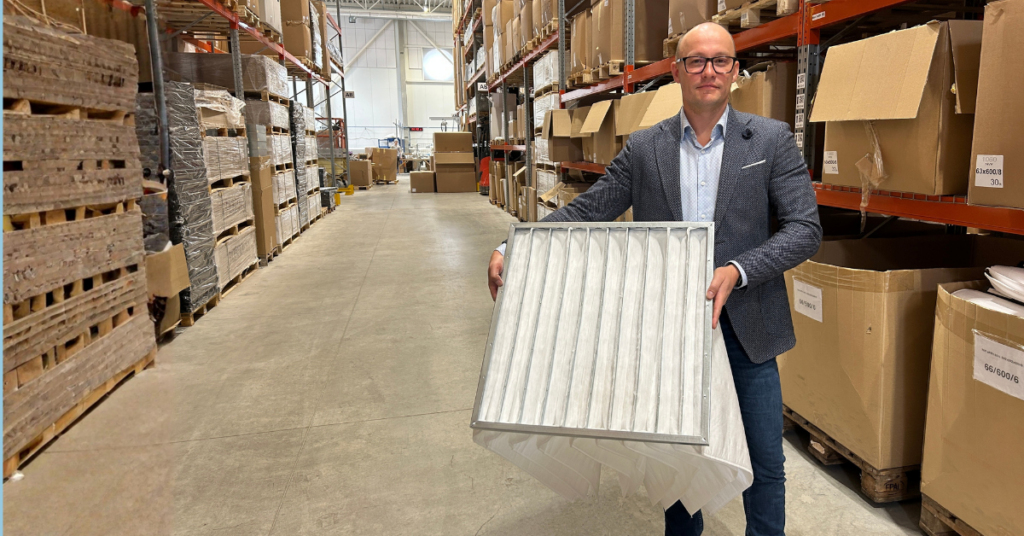
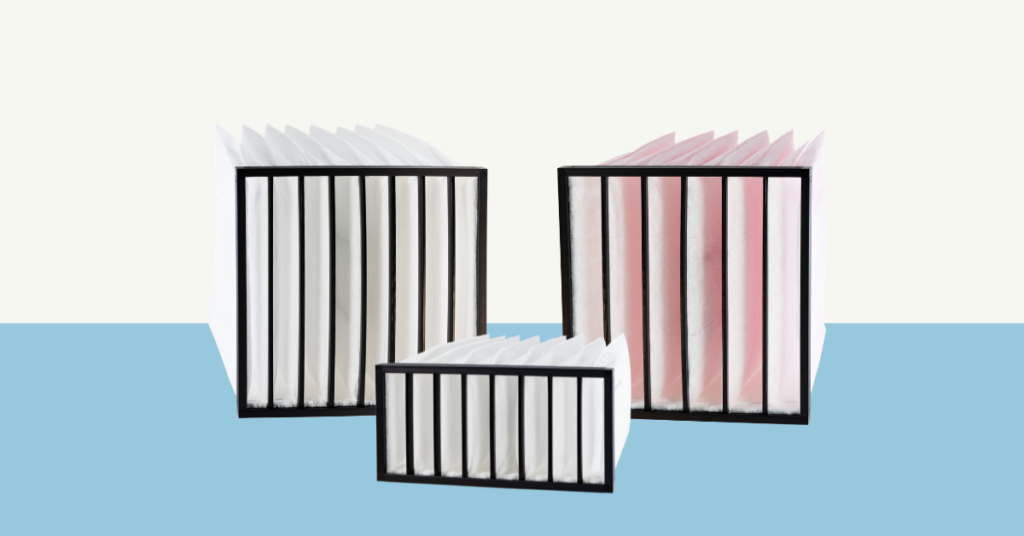
To understand this, it is important to look at measurements from independent laboratories. The Filter Plus ePM1 65% bag filter tested at the RISE laboratory in Sweden showed the following results:
- ePM1 efficiency: 65%
- initial pressure loss: 65 Pa
- end-pressure loss: 300 Pa
- dust collection capacity: 1204 g
- annual energy consumption as measured by RISE: 873 kWh/year.
It is important to point out that since the Filter Plus product is not yet Eurovent certified, it is not given a Eurovent energy class (A+, A, B, etc.) in the article. However, it is perfectly acceptable to compare the actual energy consumption with the indicative figures given in the Eurovent guide, which give an estimate of what the typical energy consumption of different filters could be, according to market standards.
According to the Eurovent 4/21 norm table, the estimated energy costs for the ePM1 60-65% category are:
- ~850 kWh/a (very low resistance filters)
- ~950 kWh/a
- ~1100 kWh/a
- ~1450 kWh/a
- ~2050 kWh/a
- 2050 kWh/a (very high resistance filters)
For example, one example filter in the Eurovent table (not Filter Plus, but only a descriptive example for comparison) consumes around 2050 kWh per year, which is typical of very high energy consuming solutions in the ePM1 60-65% category.
When these two values are compared - 873 kWh (the actual annual energy consumption of the Filter Plus filter as measured by RISE) vs 2050 kWh (the high energy consumption of the sample filter according to the Eurovent standard) - there is a clear difference:
2050 - 873 = 1177 kWh more energy per year.
This means that a high-resistance sample filter consumes about 2.35 times more energy than a Filter Plus filter. Translated into a price example, the difference is even more striking. At an electricity price of €0.15/kWh, the annual energy bill for a Filter Plus filter would be around €131, while a sample filter with a consumption of 2050 kWh would cost around €307 per year. The difference is therefore €176 per filter per year.
However, it is rare for buildings to use only one filter. If a ventilation unit has 10 filters, this means an extra cost of €1,760 per year for a sample filter. If there are 20 filters, the cost is €3520 per year, and if there are 50 filters, the cost is €8800 per year. All this is only because one filter creates more air resistance and therefore consumes more energy - the particle capture rate (ePM1 65%) is similar in both cases.
The energy consumption of filters is therefore no longer a peripheral factor, but one of the most important aspects in the design and renovation of building ventilation. Filters with lower energy consumption reduce the load on fans, prolong their lifetime, reduce vibration and noise, keep the system more stable and significantly reduce the maintenance costs of the building. In addition, lower energy consumption also means a smaller environmental footprint - less energy used means lower CO₂ emissions.
The Filter Plus ePM1 65% bag filter, with an actual energy consumption of 873 kWh per year as measured by the RISE laboratory, is therefore an example of a filtration solution that can provide a combination of good fine particle capture performance and low energy consumption. Compared to the Eurovent sample filter, which can have an energy consumption of more than 2000 kWh per year, there is a clear economic and technical advantage. Although the Filter Plus does not yet carry the Eurovent energy class label, its actual measured energy consumption is numerically documented and can be used in a fully valid way for comparing filter solutions.
Ultimately, the ISO 16890 standard helps to understand that the choice of air filter is not just a technical decision. It's a decision about health, energy efficiency, building lifetime and long-term costs. When the energy consumption of filters with the same ePM1 level can fluctuate by more than a factor of two, it is clear that the best solution is one that can combine good filtration performance with low energy costs. In the Filter Plus filter, this combination is one with real measured value, allowing science-based and economically sound decisions to be made to ensure the intake air quality of today's and future buildings.