
Ventilation systems are an essential part of modern buildings across Europe and around the world. At the same time, many industrial, office, healthcare, educational, and commercial buildings still operate ventilation systems that were installed 15, 20, or even 25 years ago. Many of these systems continue to function reliably and still fulfill their original purpose: moving large volumes of air throughout the building.
However, ventilation technology has evolved significantly over the last two decades. While older systems often operated using simple on/off controls, modern ventilation units are equipped with frequency converters, CO₂ sensors, pressure sensors, demand-controlled ventilation, and advanced energy-saving functions.
Many older systems do not have these technologies. They continue to operate at a constant rate regardless of occupancy levels or actual ventilation demand. As a result, differences in energy consumption, filtration efficiency, and indoor air quality often go unnoticed.
At the same time, air quality standards and filtration requirements have changed dramatically. Growing awareness of the health risks associated with fine particulate matter has led to the development of new filtration standards designed to measure filter performance more accurately.
This is where one of the biggest challenges in the ventilation industry begins. Many building owners, maintenance companies, and even some industry professionals still rely on filter classifications and terminology that were developed decades ago.
One of the best examples is the continued use of the term F7.
F7 – A Familiar Designation, But What Does It Mean Today?
Many professionals in the HVAC and filtration industry are familiar with the former EN 779 standard. For many years, an F7 filter was considered the standard solution for supply air filtration.
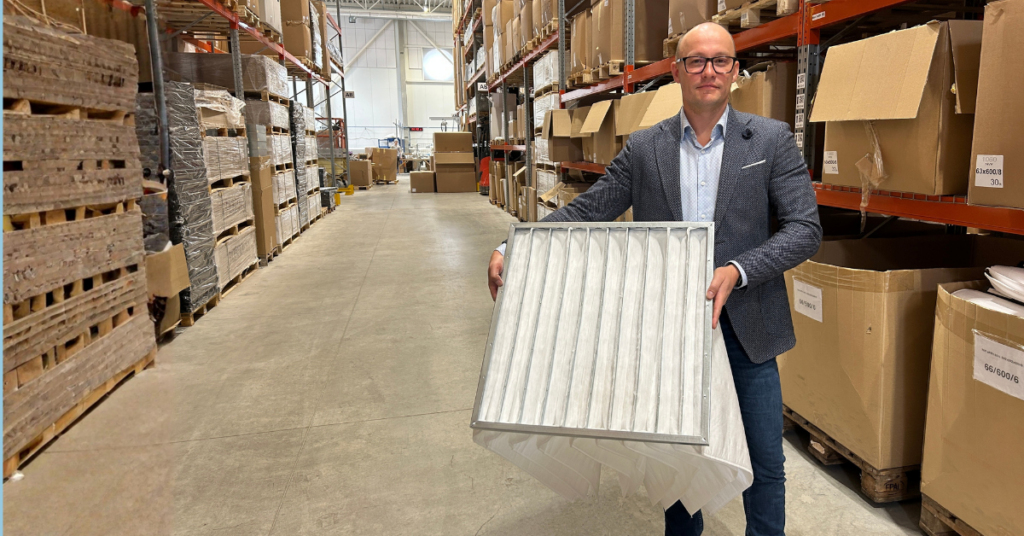
Even today, numerous filters across Europe and many other markets are still sold under the F7 designation. These products are often recognizable by their traditional pink or reddish filter media. For many building owners and maintenance companies, this appearance has become a familiar symbol of a high-quality supply air filter.
The problem is that the EN 779 standard was replaced several years ago by the international ISO 16890 standard.
The F7 designation alone no longer provides sufficient information about which particles a filter actually captures, how it contributes to indoor air quality, or how it affects the energy consumption of a ventilation system.
Therefore, the key question should no longer be whether a filter is labeled as F7, but rather which ISO 16890 classification it actually has.
Why ISO 16890 Is Essential Today
The ISO 16890 standard evaluates air filters based on their actual ability to remove particles of different sizes from the air.
Filters are classified into several categories:
- ePM10 – for larger particles
- ePM2.5 – for finer particles
- ePM1 – for the smallest and most health-relevant particles
Particular attention is given to ePM1 particles in modern air filtration.
These particles are smaller than one micrometer and can penetrate deep into the lungs, with some even entering the bloodstream. The World Health Organization (WHO) considers fine particulate matter to be one of the most significant air-related health risks worldwide. Fine particles have been linked to cardiovascular diseases, respiratory illnesses, and various forms of cancer.
For this reason, most modern ventilation equipment manufacturers now recommend ePM1 filters for supply air filtration.
Are All F7 Filters Automatically ePM1 Filters?
The short answer is: No.
One of the most common misconceptions in the market is that an F7 filter classified according to the old EN 779 standard automatically corresponds to a modern ePM1 filter. In reality, these two standards cannot be compared directly.
EN 779 and ISO 16890 are based on different testing methods and evaluation criteria. Therefore, every filter should be assessed according to its actual ISO 16890 classification rather than solely by its historical F7 designation.
In practice, many traditional F7 filters with pink or reddish filter media still exist whose actual ISO 16890 performance does not necessarily fall within the ePM1 range. Many of these products achieve classifications closer to ePM2.5 or even ePM10, meaning they primarily remove larger particles compared to modern ePM1 filters.
This means that while such filters may comply with the former F7 classification requirements, they do not necessarily provide the same level of protection against the most harmful fine particulate matter.
What makes this particularly problematic is that many filters look almost identical. The traditional pink or reddish color is still associated by many market participants with a high-quality supply air filter. In reality, however, the color says nothing about the actual ISO 16890 classification or the filter's ability to remove ePM1 particles.
Building owners and maintenance companies should therefore never rely solely on the F7 designation or the appearance of a filter. What matters are the documented ISO 16890 classification and the ventilation manufacturer's requirements.
Modern Ventilation Systems Are Designed for Specific Filters
One aspect that is often underestimated is the interaction between the ventilation system and the air filter.
Modern ventilation units are designed by manufacturers for specific filter classes. Fan performance, airflow rates, pressure drops, control strategies, and energy consumption are all calculated based on defined filter characteristics.
Many of these units also hold Eurovent certification, which documents the energy efficiency of the system.
If a manufacturer achieves an A or A+ energy rating using specific ePM1 filters, this does not automatically mean that the same energy performance will be maintained when using alternative replacement filters.
Using filters with different pressure drops, energy performance, or filtration efficiency can affect the performance of the entire system.
Possible consequences include:
- Higher energy consumption
- Reduced airflow rates
- Poorer system controllability
- Lower indoor air quality
- Increased load on fans
- Reduced service life of components
Why the Cheapest Filter Is Often the Most Expensive Solution
When purchasing air filters, many buyers initially focus on the purchase price.
In reality, however, the purchase price often represents only a small portion of a filter's total cost.
Much larger costs arise from:
- Electricity consumption
- Fan energy demand
- Maintenance requirements
- Wear and tear on ventilation equipment
- Replacement intervals
Studies show that air filters can account for approximately 10–20% of a ventilation system's energy consumption. Depending on the building type, this may correspond to around 5–10% of the total energy consumption of the building.
Therefore, the key question should not be:
"How much does this filter cost?"
Instead, it should be:
"How much will this filter cost me per year?"
Building Owners and Occupants Bear the Consequences
Ultimately, neither the filter itself nor the supplier bears the consequences of an unsuitable filter selection.
The costs are borne by the building owner.
If health-relevant fine particles are not adequately removed, indoor air quality suffers.
If the installed filters do not match the design parameters of the ventilation system, energy consumption and operating costs increase.
When filters are used whose actual performance does not meet the required specifications, the operator loses both energy efficiency and indoor air quality—two key factors that were originally invested in.
The biggest losers, however, are the people who work, study, and live in these buildings every day.
Conclusion
The HVAC and filtration industry has changed fundamentally over the past twenty years. At the same time, many outdated terms and ways of thinking from the pre-ISO 16890 era are still widely used.
The F7 designation alone no longer provides sufficient information about a filter's actual performance and offers no guarantee of protection against harmful fine particulate matter.
Before purchasing an air filter, three simple questions should always be asked:
- What is the filter's actual ISO 16890 classification?
- What is its energy consumption over its entire service life?
- Does it effectively protect building occupants from ePM1 particles?
If a ventilation equipment manufacturer specifies an ePM1 filter, there is usually a good reason for doing so. The right filter selection affects not only electricity costs, but also indoor air quality, system lifespan, and ultimately the health of the people inside the building.
The cheapest filter is therefore not always the most economical solution. Often, the best filter is the one that saves energy, delivers clean air, and allows the ventilation system to operate exactly as its manufacturer intended.