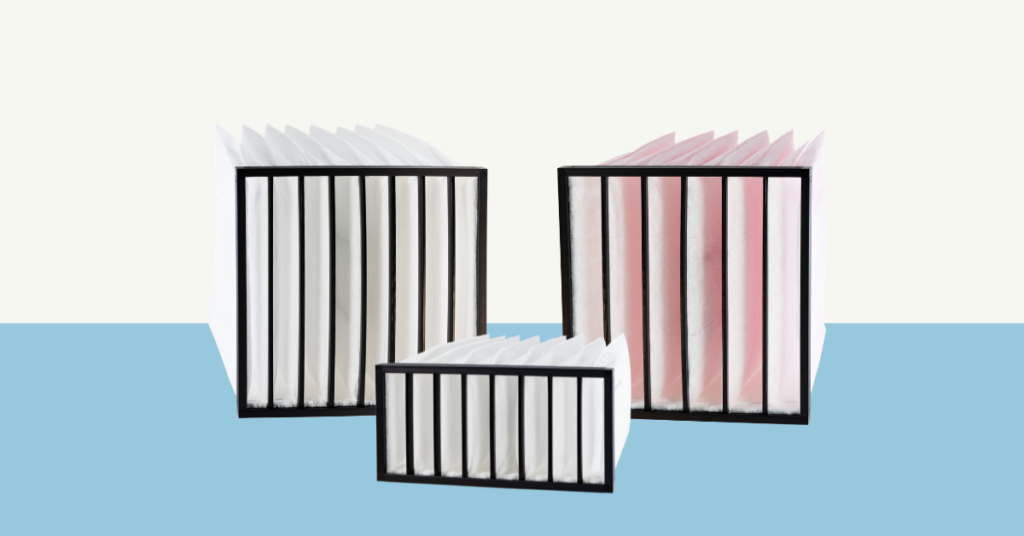
The purpose of a ventilation filter may seem simple: to remove as many pollutants and fine particles from the air as possible. In reality, however, filter and filter media design involves an important trade-off – the higher the filtration efficiency, the more difficult it usually becomes for air to pass through the filter media.
Higher airflow resistance, or pressure drop, places a greater load on the ventilation unit’s fan and increases energy consumption.
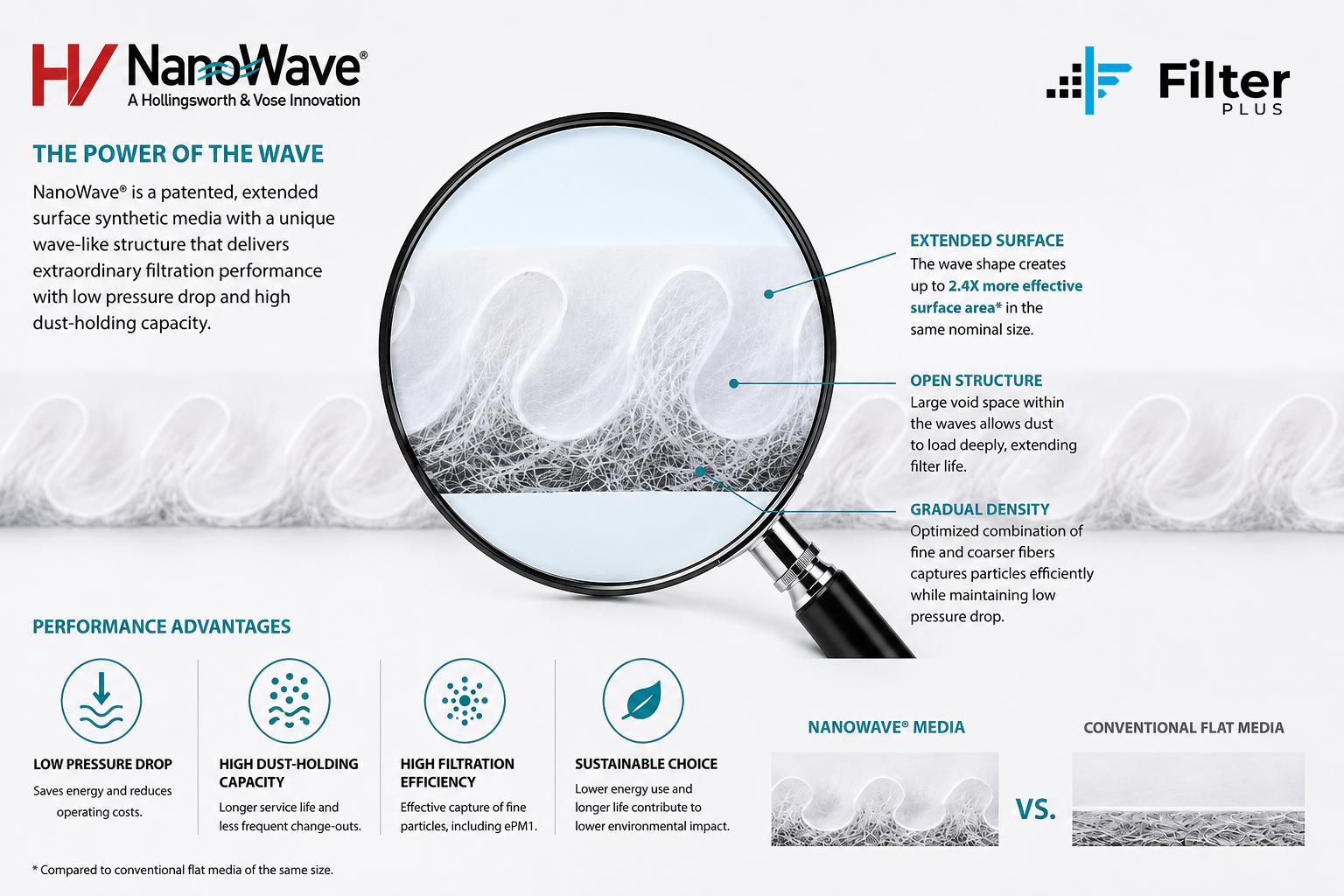
NanoWave® filter media technology is designed to reduce this compromise. Instead of achieving better filtration simply by making the filter media denser, it uses a three-dimensional wavy fiber structure that significantly increases the active filtration surface area.
The result is a synthetic filter media that combines high ePM1 filtration efficiency, low pressure drop and high dust holding capacity.
What is NanoWave® filter media?
NanoWave® is a patented synthetic filter media developed by Hollingsworth & Vose for ventilation and air filtration applications.
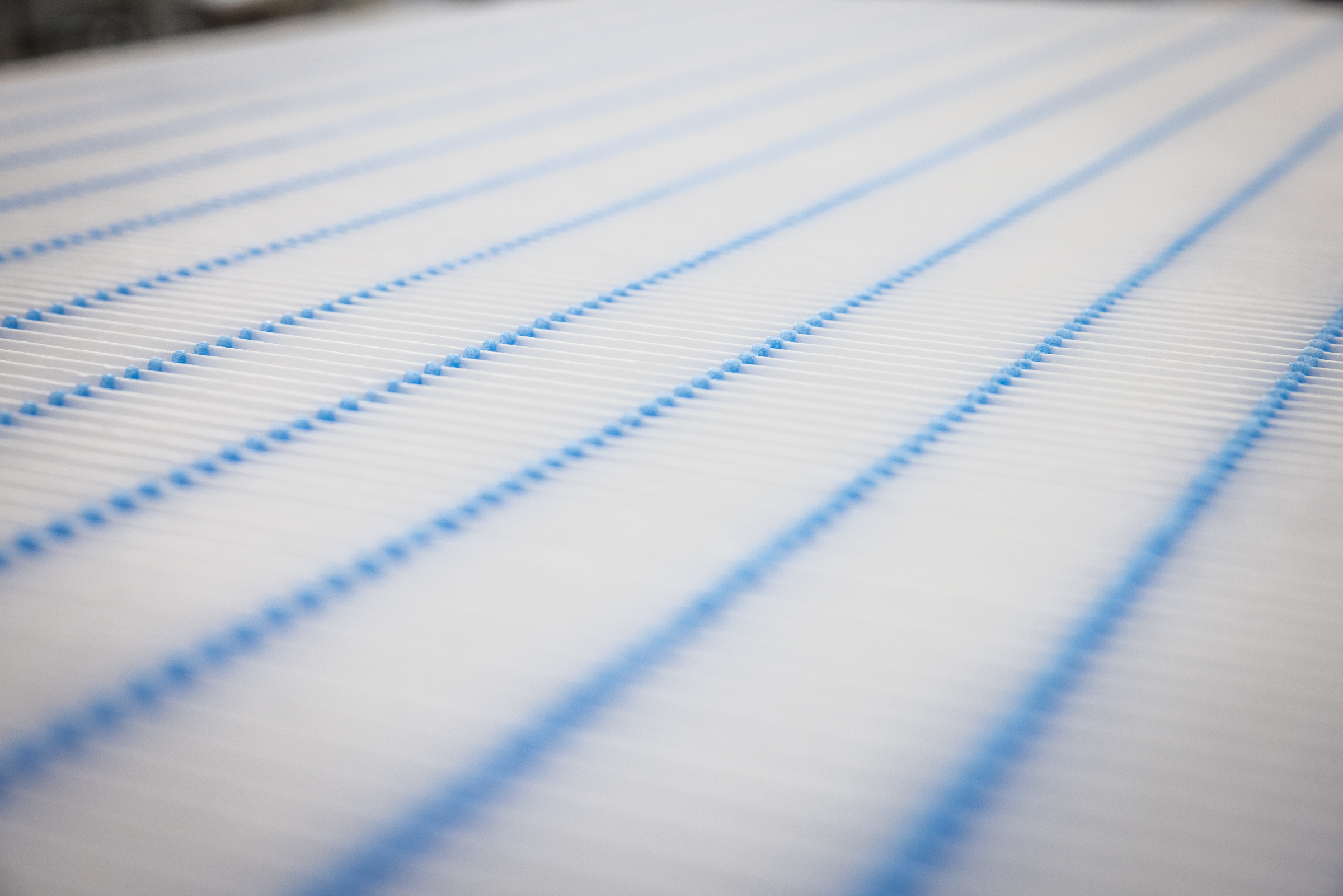
What makes NanoWave unique is its three-dimensional structure. The fine fibers of the multilayer filter media form a wavy profile protected by a prefilter layer.
Compared with conventional flat filter media, this structure allows significantly more active filtration surface area to be incorporated within the same external filter dimensions.
According to Hollingsworth & Vose, NanoWave can provide approximately 2.4 times more effective filtration surface area than conventional flat filter media of the same external size.
This larger active filtration area is one of the key advantages of NanoWave technology.
Why is a larger filtration area important?
Imagine one hundred people trying to enter a building. If everyone has to pass through one narrow doorway, a queue quickly forms. If the same number of people can use several wide doors, movement becomes much easier.
A similar principle applies to air moving through a filter.
When the same airflow is distributed across a larger filter surface, the air velocity through the filter media decreases. This makes it possible to achieve high filtration efficiency with a lower pressure drop.
For a ventilation system, this has a direct impact: the lower the filter pressure drop, the less work the fan has to do to move the same volume of air.
A filter therefore affects more than just indoor air quality. Its design also influences the energy consumption of the ventilation system.
Three main benefits of NanoWave® media pocket filters
The strength of NanoWave technology lies in combining three important characteristics.
1. High ePM1 filtration efficiency
ePM1 particles are among the smallest airborne particles, and effectively removing them is one of the key objectives of modern ventilation.
NanoWave technology makes it possible to manufacture filters with high ePM1 efficiency without relying simply on increasingly dense filter media.
2. Low pressure drop
Achieving high filtration efficiency with a low pressure drop is one of the key advantages of NanoWave.
A filter with a lower pressure drop reduces the load on the ventilation unit’s fan. Since a ventilation system may operate for thousands of hours each year, even a relatively small difference in filter pressure drop can influence annual energy consumption.
For this reason, pressure drop should always be considered alongside the ISO 16890 classification when comparing filters.
3. High dust holding capacity
The initial pressure drop of a new filter is only one part of its actual performance.
During use, more and more dust accumulates in the filter, causing the pressure drop to increase. A good filter must be able to hold a large amount of dust while keeping the increase in pressure drop as controlled as possible.
NanoWave’s large active filtration surface helps distribute the dust load over a wider area. This enables high dust holding capacity and supports stable filter performance throughout its service life.
What did the independent laboratory test of the Filter Plus NanoWave® pocket filter show?
In 2026, Filter Plus had its NanoWave-based FPX pocket filter independently tested at RISE Research Institutes of Sweden.
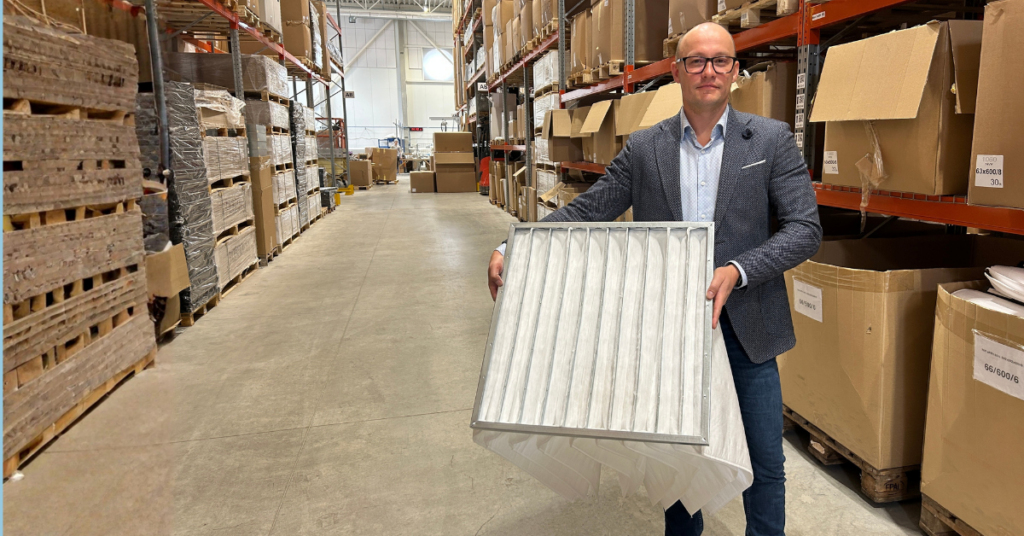
The tested filter had dimensions of 592 × 592 × 635 mm, featured 10 pockets, and had an effective filtration area of approximately 7.7 m².
The ISO 16890 test result was:
ISO ePM1 85%
The initial pressure drop at the nominal airflow of 0.944 m³/s was:
79 Pa
During the test, the filter was able to collect 1,321 grams of test dust before reaching the specified final pressure drop.
These results demonstrate the main objective of NanoWave technology: high fine-particle filtration efficiency combined with a low initial pressure drop and high dust holding capacity.
Why does a pocket filter affect ventilation energy consumption?
VThe fan in a ventilation unit must overcome the total airflow resistance generated throughout the system. The air filter is one of the sources of this resistance.
As the filter pressure drop increases, the fan has to work harder to maintain the required airflow. This is why filter selection should not be based solely on purchase price and filter class.
It is also important to consider how the filter performs throughout its entire service life.
Based on the laboratory test, the standardized annual energy consumption of the Filter Plus FPX NanoWave pocket filter was calculated at 1,046 kWh per filter.
At an electricity price of €0.15/kWh, this would correspond to approximately €157 per year.
Actual energy consumption naturally depends on the ventilation system’s operating hours, airflow, fan efficiency, filter loading and other operating conditions. However, the standardized value makes it possible to compare different filters on the same basis.
NanoWave® pocket filters are designed for applications where overall filter performance matters
When selecting a filter, it is not enough to look at just one technical parameter.
High ePM1 efficiency is important, but equally important is the pressure drop at which that efficiency is achieved and how the filter performs as dust accumulates.
When choosing pocket filters, it is therefore worth asking:
- What is the filter’s ISO 16890 classification?
- What is the initial pressure drop?
- How does the pressure drop change during use?
- What is the filter’s dust holding capacity?
- What is the effective filtration surface area?
- What is the standardized energy consumption?
NanoWave® technology makes it possible to combine these characteristics in a single pocket filter: high ePM1 filtration efficiency, low pressure drop and high dust holding capacity.
Independent ISO 16890 laboratory testing of the Filter Plus FPX NanoWave pocket filter confirms that the technology also performs in practice – the tested filter achieved an ePM1 85% classification, an initial pressure drop of 79 Pa and a dust holding capacity of 1,321 g.
If you are looking for a pocket filter for a ventilation system where clean air, low energy consumption and long service life are all important, it is worth looking beyond the purchase price alone.
A good filter does more than clean the air – it helps the entire ventilation system operate more efficiently.